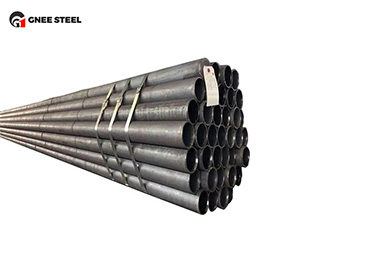
H-type finned tubes are heat exchanger elements used for heat exchange. They typically consist of a tube and numerous closely spaced fins, which can be fixed to the tube or seamlessly connected to it. These fins are usually shaped like the letter "H," hence the name H-type finned tube.
.png) Working Principle
Working Principle
H-type finned tubes improve the heat transfer efficiency of the heat exchanger by increasing the surface area. When hot and cold fluids flow through the inside and outside of the finned tube respectively, heat is rapidly transferred to the fluid on the other side through the fins, thus achieving heat exchange. Due to the shape and arrangement of the fins, heat transfer is more efficient while reducing the required floor space.
Main Features
High-efficiency heat transfer: H-type finned tubes significantly improve heat transfer efficiency by increasing the fin surface area.
Reduced floor space: Due to the close arrangement of the fins, H-type finned tubes reduce the floor space required while providing efficient heat transfer.
Corrosion resistance: H-type finned tubes can be manufactured from corrosion-resistant materials such as stainless steel and alloy steel, making them suitable for various corrosive environments.
High Adaptability: H-type finned tubes can be customized to meet various needs, such as fin shape, material, and size, to suit different application scenarios.
.png) Application Areas
Application Areas
H-type finned tubes have wide applications in multiple industrial sectors, including but not limited to:
Boiler Industry: Used for heat transfer and flue gas emission, improving boiler thermal efficiency.
Power Industry: Used in power plants to cool furnaces, boilers, condensers, and other equipment, improving cooling efficiency and reducing energy consumption.
Petrochemical Industry: Used for heat transfer and cooling in heat exchangers, evaporators, condensers, and other equipment in the oil and gas and other petrochemical industries.
Steel Industry: Used for cooling and flue gas emission in blast furnaces, converters, steelmaking equipment, and other equipment.
Chemical Industry: Used for heat transfer and cooling in heat exchangers, condensers, and other equipment in the fertilizer, plastics, and rubber chemical industries.
Food Industry: Used for heat transfer and flue gas emission in steam generators, cookers, drying equipment, and other equipment during food processing.
Pharmaceutical industry: Used for heat transfer and cooling in equipment such as pyrolysis tanks, dryers, and distillers during the pharmaceutical production process.
.jpg)
.jpg)