

ASTM A268 STEEL PIPE
ASTM A268 is the standard specification for seamless and welded ferritic and martensitic stainless steel tubing for general service.

Casing is the permanent, cemented or suspended pipe that lines the wellbore, isolates formations and contains pressure. In a deep well, the same basic function carries far greater consequences. A deep string may weigh thousands of tonnes in air, so the top joints see enormous axial tension; the bottom joints see high external collapse from overburden and high internal burst from the reservoir. "Deep" is commonly taken to start around 15,000 ft (4,500 m) total vertical depth, with "ultra-deep" beyond roughly 20,000 ft (6,100 m). Deep wells also expose the string to bottomhole temperatures that can exceed 300 °F (150 °C), which lowers the effective yield of the steel and must be accounted for in design.
Shallow wells can be built with J55 or K55 casing. As depth and pressure rise, the design is governed by burst, collapse and especially axial tension, and the grade must move up the API 5CT strength ladder. The two grades that define deep and ultra-deep programs are:
Both are selected from the well's burst, collapse and tension design, with the grade verified against downhole temperature using deration, not ambient properties.
| Grade | Yield (psi) | Min. tensile (psi) | Sour-service? | Typical deep-well role |
|---|---|---|---|---|
| N80 / L80 | 80,000–110,000 / 80,000–95,000 | 95,000 / 95,000 | L80-1 yes | Lower-load or upper tapered sections |
| P110 | 110,000–140,000 | 125,000 (862 MPa) | No | High-tension deep strings |
| Q125 | 125,000–150,000 | 135,000 | Type 2/3/4 yes | Ultra-deep / highest-load strings |
| C110 | 110,000–140,000 | 125,000 | Yes (restricted) | Sour deep wells (H2S) |
Deep casing strings are tension-dominated, so the connection — not just the pipe body — must carry the load. Connections are threaded and inspected to API Spec 5B:
Deep well casing uses the same API Spec 5CT outside-diameter series as other casing — commonly 4-1/2 in (114.3 mm) up to 20 in (508 mm) for the production and intermediate strings that reach depth, with 7 in, 9-5/8 in, 13-3/8 in and 20 in among the sizes run in deep programs. Longer R3 joints (10.36–14.63 m) are favored in deep wells because fewer connections means fewer tension-critical joints per string and faster running.
Deep wells are rarely a single grade and weight from top to bottom. A tapered casing string combines different grades, wall thicknesses and sometimes connections in one continuous string so that each section is matched to its load:
Deep well casing is produced as seamless pipe (hot-rolled from solid billet), the dominant form where pressure integrity and homogeneity over long lengths are critical. Because deep strings are safety-critical, they are typically ordered to PSL-2 or PSL-3 with controls beyond the PSL-1 baseline:
GNEE supplies API Spec 5CT / ISO 11960 deep well casing in P110, Q125 and supporting grades, seamless, with BTC or premium connections and PSL-2/PSL-3 documentation. Indicative FOB China pricing for high-strength grades such as P110 generally falls in the range of US$1,100 to 1,500 per ton, moving with steel market conditions and depending on grade, size and PSL level. Standard items typically ship in 20 to 45 days; quenched-and-tempered grades with impact (CVN) testing can require the longer end of that window. Firm quotations follow the specification and order volume, with CIF/CFR terms available on request.
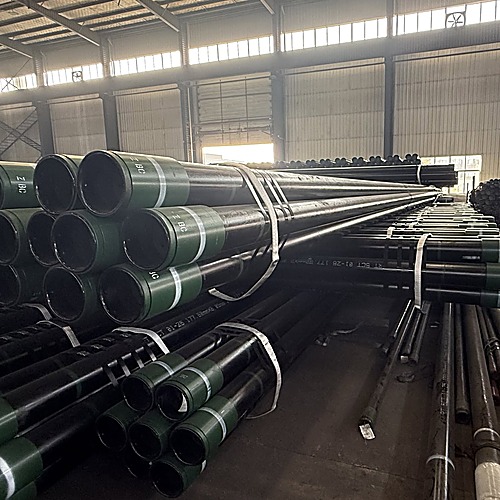
Deep well casing is the high-strength casing string run in wells whose total vertical depth typically exceeds about 15,000 ft (4,500 m), with ultra-deep wells beyond roughly 20,000 ft (6,100 m). The casing must carry the weight of a long string, resist high collapse and burst from deep formations, and perform under elevated temperatures, so it is specified to API Spec 5CT / ISO 11960 in higher-strength grades than shallow wells.
Deep well casing is most often specified in P110 (yield 110,000-140,000 psi / 758-965 MPa, min tensile 125,000 psi / 862 MPa) and Q125 (yield 125,000-150,000 psi), with N80 or L80 used in lower-load sections of a tapered string. For sour (H2S) deep wells, P110 is not a sulfide-stress-cracking-resistant grade; C110 or sour-service Q125 should be selected in line with NACE MR0175 / ISO 15156.
Deep casing strings carry very high axial tension from their own weight and from running. The buttress (BTC) connection machined per API Spec 5B delivers joint strength approaching 100% of the pipe body, versus about 95-98% for long round thread (LTC), so BTC is the default for deep and high-tension strings. Premium metal-to-metal-seal connections are used where gas-tight sealing or HPHT conditions govern.
A tapered casing string uses different grades, wall thicknesses and sometimes connections in different sections of the same well. The upper sections carry most of the string weight and are specified in high-strength, heavier-wall pipe, while deeper sections are selected for collapse and burst resistance. The design also applies temperature deration so that the yield used in calculations reflects downhole temperature rather than ambient values.
No. P110 is a high-strength grade but is not qualified as sulfide-stress-cracking resistant under NACE MR0175 / ISO 15156. Where deep wells encounter H2S, a sour-service grade such as C110 or a sour-service type of Q125 must be specified, with hardness and heat-treatment controls verified on the mill test certificate.
Indicative FOB China pricing for high-strength deep well casing such as P110 generally falls in the range of US$1,100 to 1,500 per ton, moving with steel market conditions and depending on grade, size and PSL level. Standard items typically ship in 20 to 45 days; quenched-and-tempered grades with impact (CVN) testing can require the longer end of that window.
Send your deep well casing program — outside diameter, wall thickness or weight per unit length, grade, connection, PSL level, well depth and quantity — and our technical team will return a firm quotation with lead time and shipping terms. For the P110 product range and size chart, see the API 5CT P110 deep well casing product page.