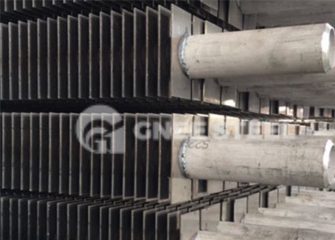
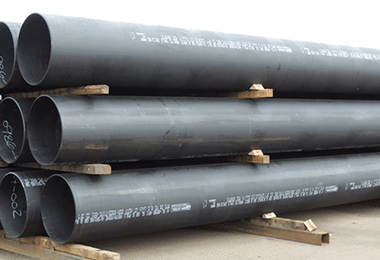
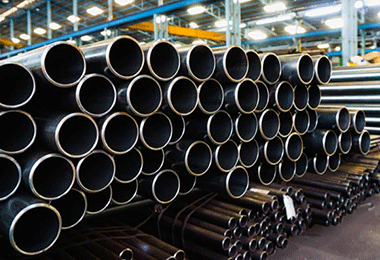
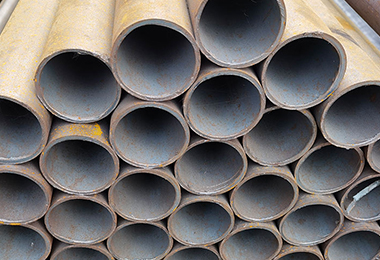
X52 line pipe is supplied in PSL1 and PSL2, seamless from 21.3 mm to 660 mm outside diameter (1/2 to 26 in), ERW and HFW to 508 mm, and LSAW or SSAW from 406 mm to 2500 mm. Wall follows the schedule range from SCH 10 to XXS or the project wall, lengths run single random, double random or fixed at 6 and 12 m. PSL2 grades are ordered as X52N, X52Q or X52M, and as X52NS, X52QS or X52MS when Annex H sour service applies. Ends are plain or bevelled to 30 degrees with a 1.6 mm root face, three-layer polyethylene, three-layer polypropylene and fusion bonded epoxy coatings are applied before shipment, and every order ships with an EN 10204 3.1 certificate, with 3.2 available when a third-party inspector is named.
The differences at a glance
Most of these come from API 5L's own tables rather than from the grade, which is why they read as small print. They are not small print. Two of them — repair welding and weld frequency — cannot be detected in a delivered pipe at all.
| Requirement |
PSL1 |
PSL2 |
| Grade range covered |
Grade B through X70 |
Grade B through X80 |
| Size range, Table 1 |
0.405 in to 80 in |
2.375 in to 80 in |
| Pipe ends |
Plain, threaded, bevelled, special coupling |
Plain-end |
| Maximum yield |
Not specified |
Specified for each grade |
| Maximum tensile |
Not specified |
Specified for each grade |
| Carbon equivalent |
None |
CEIIW and CEPcm, per grade |
| Charpy impact |
Only when the purchaser specifies it |
Required for all grades |
| Non-destructive inspection |
Not required |
Required on every pipe |
| Weld heat treatment, electric welds |
Grades above X42 |
All grades |
| Seam weld frequency |
No minimum |
100 kHz minimum |
| Laser welding |
Permitted |
Not permitted |
| Repair welding of body, plate or skelp |
Permitted by agreement |
Prohibited |
| Certification |
Only when specified as a supplementary requirement |
Mandatory |
| Traceability |
Until tests are passed, unless specified |
Mandatory after tests |
Mechanical Difference
| Property |
X52 PSL1 |
X52 PSL2 |
| Yield strength, minimum |
360 MPa (52,200 psi) |
360 MPa (52,200 psi) |
| Yield strength, maximum |
Not specified |
530 MPa (76,900 psi) |
| Tensile strength, minimum |
460 MPa (66,700 psi) |
460 MPa (66,700 psi) |
| Tensile strength, maximum |
Not specified |
760 MPa (110,200 psi) |
| Yield to tensile ratio |
Not specified |
≤ 0.93, for OD > 323.9 mm |
| Weld seam tensile, minimum |
460 MPa (66,700 psi) |
460 MPa (66,700 psi) |
| Elongation |
Per API 5L formula |
Per API 5L formula |
| Charpy impact |
Not required |
Required |
| Delivery condition |
As-rolled, normalized, TMCP, normalized and tempered |
X52N, X52Q or X52M |
Chemistry Difference
| Element, % max |
PSL1, seamless |
PSL1, welded |
X52N |
X52Q |
X52M |
| C |
0.28 |
0.26 |
0.24 |
0.18 |
0.22 |
| Si |
— |
— |
0.45 |
0.45 |
0.45 |
| Mn |
1.40 |
1.40 |
1.40 |
1.50 |
1.40 |
| P |
0.030 |
0.030 |
0.025 |
0.025 |
0.025 |
| S |
0.030 |
0.030 |
0.015 |
0.015 |
0.015 |
| V |
Nb+V+Ti ≤ 0.15 |
0.10 |
0.05 |
Nb+V+Ti ≤ 0.15 |
| Nb |
Nb+V+Ti ≤ 0.15 |
0.05 |
0.05 |
| Ti |
Nb+V+Ti ≤ 0.15 |
0.04 |
0.04 |
| CEIIW |
Not specified |
0.43 |
0.43 |
0.43 |
| CEPcm |
Not specified |
0.25 |
0.25 |
0.25 |
| Cu / Ni / Cr |
0.50 each |
0.50 / 0.30 / 0.30 |
Q is a PSL2 letter only
One consequence of the delivery condition table that surprises buyers: there is no X52Q in PSL1. The PSL1 list for X42 through X70 covers as-rolled, normalizing rolled, thermomechanical rolled, thermo-mechanical formed, normalizing formed, normalized, and normalized and tempered. Quenched and tempered appears in the PSL1 table only for Grade B seamless, and only by agreement.
So a specification asking for quenched and tempered X52 has already chosen PSL2, whether or not it says so. The same applies to the suffix letters themselves: R, N, Q and M belong to PSL2 grades, and PSL1 X52 carries no suffix at all. An enquiry that reads "X52R PSL1" is asking for something the standard does not define.
PSL1 VS PSL2 Testing
| Test |
X52 PSL1 |
X52 PSL2 |
| Hydrostatic, every pipe |
Required |
Required, NDT cannot substitute |
| Charpy impact (CVN) |
Not required |
Required at 0 °C by default |
| Absorbed energy, pipe body |
— |
27 J average transverse, 41 J longitudinal at common sizes |
| CVN locations, welded pipe |
— |
Body, weld seam and heat-affected zone |
| Drop weight tear test |
Not required |
Where the specification calls for it |
| Non-destructive examination |
Not required |
Every pipe, full seam length |
| Weld tensile |
Required |
Required |
| Flattening, bend, guided bend |
Required |
Required |
FAQ
Is PSL2 X52 stronger than PSL1 X52?
No. Both are 360 MPa minimum yield and 460 MPa minimum tensile. PSL2 adds a maximum, 530 MPa yield and 760 MPa tensile, and a 0.93 yield-to-tensile ratio above 323.9 mm. The minimum does not move, so the wall thickness does not move either.
Can I order X52Q as PSL1?
No. Quenched and tempered is not a permitted delivery condition for PSL1 X52. The PSL1 list stops at normalized and tempered; Q&T appears in that table only for Grade B seamless by agreement. Asking for X52Q is asking for PSL2.
What carbon equivalent applies to X52 PSL2?
0.43 by the CEIIW formula where carbon exceeds 0.12%, and 0.25 by CEPcm where carbon is 0.12% or below. The trigger is the measured carbon on the heat, not the table maximum, so a low-carbon thermomechanically rolled heat is assessed on Pcm instead.
Does PSL1 require impact testing?
Not by default. Charpy testing at PSL1 comes in only if the purchaser invokes the supplementary requirement. At PSL2 it is mandatory, at 0 °C unless another temperature is specified, and on welded pipe it covers the body, the seam and the heat-affected zone.
Is the hydrostatic test enough without seam NDT?
It is not equivalent. The hydro test proves the pipe holds pressure; it does not reliably open a tight planar seam defect, which is the failure mode that matters on an electric-welded seam. PSL1 relies on the hydro test alone. PSL2 requires full-length seam inspection on every pipe.
Which delivery condition should I specify?
X52M for most welded line pipe, because thermomechanical rolling gives the toughness with the lowest carbon. X52N where a normalizing route suits the mill and the wall. X52Q for heavy wall, tight strength windows and anything where hardness uniformity through the wall matters.
Can PSL1 pipe be used for sour service?
No. Annex H applies to PSL2 only. A sour order needs the S suffix, sulfur at 0.003%, a 250 HV10 hardness cap and HIC and SSC test reports. A PSL1 X52 with 0.030% sulfur has none of that and should not be considered for wet H2S on price grounds.