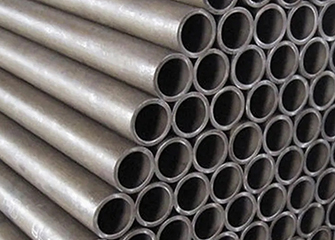
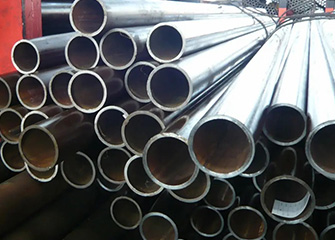
N80 Grade and Black Coating
- API 5CT: the American Petroleum Institute specification for casing, tubing and accessory components used in oil, gas, geothermal and water wells, with three Product Specification Levels (PSL-1, PSL-2, PSL-3).
- N80 Grade: a medium-high strength carbon-manganese steel in API 5CT Group 1, delivered as N80-1 or N80Q. Both share identical strength minima but differ on heat treatment and toughness control.
- Production Tubing: the pipe string run inside the casing to convey crude oil and natural gas from the reservoir to the surface and to contain well pressure during production.
- Black Coating (mill varnish / paint): a thin, dark rust-preventive layer applied at the mill. It protects against incidental condensation, handling marks and atmospheric rust during storage and transit; it is not a structural coating and is distinct from the heavy external systems used on buried pipelines.
N80-1 versus N80Q — The Tubing Decision
N80-1 may be delivered normalized, normalized-and-tempered or quench-and-tempered, while N80Q must be quench-and-tempered only — Q+T is the sole permitted route. N80Q therefore guarantees a uniform tempered-martensitic microstructure, mandatory Charpy V-notch verification and tighter property consistency. For shallow to moderate sweet wells under roughly 2,500 m, N80-1 is cost-optimized; for deeper strings, cold-climate or offshore service, or where a documented Q+T record is mandated, N80Q is the safe selection. The heat-treatment choice does not change the black coating, but it governs the string's toughness margin.
Chemical Composition (%)
| Element |
C |
Mn |
Si |
P |
S |
Cr |
V |
| Typical heat analysis (representative 36Mn2V-type) |
0.34–0.38 |
1.45–1.70 |
0.20–0.35 |
≤ 0.020 |
≤ 0.015 |
≤ 0.15 |
0.11–0.16 |
API Spec 5CT fixes only the phosphorus and sulfur maxima for N80 (≤ 0.030 each in the standard table; many mills hold tighter limits as shown). For N80Q it additionally limits C ≤ 0.43 and Mn ≤ 1.90 with the other elements manufacturer-controlled. Carbon, manganese, silicon, chromium, molybdenum and vanadium are defined by the manufacturer to meet the mechanical requirements and are recorded on the mill test certificate. Confirm the exact heat analysis against the order MTC.
Mechanical Properties
| Property |
Imperial |
Metric |
| Minimum yield strength |
80,000 psi |
552 MPa |
| Maximum yield strength |
110,000 psi |
758 MPa |
| Minimum tensile strength |
100,000 psi |
689 MPa |
| Elongation under load |
Per API 5CT formula (depends on wall thickness) |
| Hardness limit (N80Q) |
≤ 241 HBW |
| Charpy V-notch (N80Q) |
Mandatory per batch; N80-1 optional unless specified |
N80-1 and N80Q share the same strength minima. The practical difference is microstructure uniformity and impact-toughness consistency, not the design minimums.
Dimensions and Weight
| OD — inches (mm) |
Nominal Weight — lb/ft (kg/m) |
Wall Thickness — mm |
Standard End Finish |
| 1.050" (26.7) |
2.69 – 3.36 (4.00 – 5.00) |
2.87 – 3.18 |
NUE / EUE |
| 1.900" (48.3) |
4.00 – 5.00 (5.95 – 7.44) |
2.87 – 3.68 |
NUE / EUE |
| 2-3/8" (60.3) |
3.66 – 5.73 (5.44 – 8.53) |
2.87 – 4.83 |
NUE / EUE |
| 2-7/8" (73.0) |
4.33 – 6.85 (6.44 – 10.20) |
3.05 – 5.51 |
NUE / EUE |
| 3-1/2" (88.9) |
5.41 – 10.08 (8.05 – 15.00) |
3.18 – 6.45 |
NUE / EUE |
| 4" (101.6) |
6.72 – 12.10 (10.00 – 18.00) |
3.18 – 6.50 |
NUE / EUE |
| 4-1/2" (114.3) |
8.06 – 14.78 (12.00 – 22.00) |
3.18 – 6.88 |
NUE / EUE |
Weights are representative API 5CT nominal weights for EUE tubing; kg/m conversions are approximate. The complete API 5CT size, weight and drift list for each connection is provided in the quotation. Sizes up to 4-1/2" (114.3 mm) outside diameter and wall thickness to 16.00 mm are available on request.
Tubing Length Ranges
| Length Range |
Length — m |
Length — ft |
| Range 1 (R1) |
6.10 – 7.32 |
20.0 – 24.0 |
| Range 2 (R2) |
8.53 – 9.75 |
28.0 – 32.0 |
| Range 3 (R3) |
11.58 – 12.80 |
38.0 – 42.0 |
R2 is the most common supply length for tubing because it reduces connections per string and simplifies running; R3 is used for long-export and high-volume programs.
Dimensional Tolerances
| Item / Parameter |
Tolerance Requirement |
Remarks |
| Outside diameter, D ≤ 4-1/2" (114.3 mm) |
± 0.79 mm |
Small-diameter tubing body |
| Outside diameter, D > 4-1/2" (114.3 mm) |
± 0.75% of OD |
Where larger tubing is specified |
| Wall thickness |
− 12.5% of nominal |
No specific upper limit; controlled via weight |
| Weight — single length |
+ 6.5% / − 3.5% |
Individual pipe tolerance |
| Weight — total order (batch) |
− 1.75% |
Batch-level tolerance |
| Straightness |
≤ 0.2% of total length |
Last 1.5 m held to 3.18 mm |
Tolerances are per API Spec 5CT for PSL-1; PSL-2 and PSL-3 may add supplementary requirements. Confirm against the specific PSL level on the order.
Black Coating — Process and Specification
The black finish is applied after inspection and before threading: the cleaned pipe is dipped or sprayed with a black rust-preventive varnish or paint and air-dried. A typical mill varnish is supplied at a dry-film thickness of roughly 20–60 µm, sufficient to inhibit atmospheric rust for the storage and transit period. It is compatible with subsequent welding, bending and fabrication — the film is simply removed locally at the weld prep and field joint. For projects that later require a permanent system, the black-coated tubing is an ideal base because the surface is clean and the coating is easily removed. Specify the finish on the purchase order as "black varnish / black paint, mill-applied" and, where it matters, the agreed dry-film thickness.
Black Coating vs Other Finishes
| Finish |
Protection Level |
Typical Use |
Notes |
| Bare (mill oxide) |
None / incidental |
Interim, immediate use |
Rusts without protection; stains easily |
| Black varnish / paint |
Light, short-term |
Storage, transit, dry handling, downhole |
Economical; not for buried / sour service |
| Hot-dip galvanized |
Moderate (sacrificial Zn) |
Atmospheric, water lines |
Zinc layer damaged by welding and high temperature |
| Fusion-bonded epoxy (FBE) |
High, permanent |
Buried pipelines |
AMPP-recognized external coating |
| 3LPE / 3LPP |
Very high + mechanical |
Buried, harsh environments |
Used on line pipe, not typically on OCTG tubing |
For tubing that is run downhole, the well fluid itself protects the string, so a light black finish is usually sufficient. Only where the pipe is buried, submerged, exposed to H2S or placed in aggressive chemical service should a permanent external coating and the correct sour-service grade be specified.
Manufacturing and Inspection
- Seamless (SML): hot-rolled from solid billet; the dominant form for OCTG tubing and preferred where pressure integrity and uniform properties matter.
- Heat treatment: N80-1 normalized or normalized-and-tempered at the mill's discretion; N80Q quench-and-tempered with the austenitizing temperature, quench medium and temper temperature recorded for traceability.
- Threading and coating: ends are threaded and coupled to API Spec 5B (NUE/EUE/IJ) after the black coating is applied, with couplings supplied separately or pre-assembled.
Every length is drift-tested, hydrostatic-tested and threaded-gauged before shipment, with NDT per the specified PSL level and the black finish inspected for continuous, holiday-free coverage.
Applications and Well Selection
- Production tubing in oil, gas, coalbed-methane and geothermal wells roughly 1,500–4,000 m deep, where N80's strength-to-cost ratio is the sweet spot
- Wells with dry or non-aggressive well fluids, where the well environment protects the string and a black finish covers storage and transit
- Temporary or staged projects where a permanent coating is applied later, or where the tubing is stored and shipped before running
- Cost-sensitive programs that need N80 strength without paying for a permanent FBE or 3LPE system the downhole service does not require
Where H₂S is present, sour-service grades such as L80 Type 1, C90 or T95 should be specified instead, in line with NACE MR0175 / ISO 15156. N80 is a conventional carbon steel without anti-sulfur formulation, and the black coating provides no sulfide-stress-cracking protection.
FAQ
What does "black coating" mean on API 5CT N80 tubing?
On OCTG, "black coating" refers to the mill-applied black varnish or black paint finish, not a structural change to the alloy. It is a thin rust-preventive layer, typically 20-60 micrometers dry film, sprayed or dipped at the mill to protect the surface against atmospheric rust during storage, handling and transit. The base metal remains ordinary API 5CT N80 carbon steel.
Is black-coated N80 tubing corrosion-proof, and where is it not suitable?
No. Black varnish or paint is a short-term, light protective finish, not a permanent corrosion-control system. It is appropriate for dry indoor storage, covered yard storage and transit protection. It is not a substitute for fusion-bonded epoxy (FBE), 3LPE or cathodic protection in buried, submerged, sour (H2S) or aggressive chemical service, where the film degrades and the underlying steel corrodes.
When should I choose black coating instead of bare, galvanized or FBE/3LPE tubing?
Choose black coating when the tubing needs only economical transit and storage protection and will be run in a well where the well fluid protects the string, or where a final protective system is applied later. Bare pipe gives no rust protection. Galvanizing adds sacrificial zinc but the zinc layer is damaged by welding and high temperature. FBE and 3LPE are permanent external systems for buried pipelines and are unnecessary, and costly, for downhole tubing.
What end finishes (NUE, EUE, IJ) are available for N80 black-coated tubing?
API 5CT tubing is supplied as Plain End (PE), Non-Upset End (NUE), External Upset End (EUE) or Integral Joint (IJ). NUE and EUE are the threaded-and-coupled designs most commonly ordered; EUE carries a thicker upset for higher pressure and is the default for production tubing. The black coating is applied before threading, and the coupling is supplied separately or pre-assembled.
What is the difference between N80-1 and N80Q for tubing, and does it affect the coating?
Both sub-grades share identical strength minima: yield 552-758 MPa and tensile at least 689 MPa. N80-1 may be normalized, normalized-and-tempered or quench-and-tempered, while N80Q must be quench-and-tempered only, giving a uniform tempered-martensitic microstructure and mandatory impact verification. The heat-treatment route does not change the black coating, but N80Q is the preferred choice for deeper, colder or higher-load tubing strings where toughness consistency matters.
What outside-diameter, wall-thickness and length ranges apply to N80 tubing?
API 5CT N80 tubing is produced from 1.05 in (26.7 mm) to 4-1/2 in (114.3 mm) outside diameter, with wall thickness from about 2.87 mm to 16.00 mm. Lengths follow API ranges R1 (6.10-7.32 m), R2 (8.53-9.75 m) and R3 (11.58-12.80 m), with R2 the most common for tubing. Exact nominal weights and drift diameters follow the standard for each size and connection.
Can black-coated N80 tubing be used in sour (H2S) service?
No. N80 is a Group 1 carbon steel grade without a mandatory NACE MR0175 / ISO 15156 sour-service rating. For wells with H2S, specify L80 Type 1, C90, T95 or a higher-grade sour-resistant tubing under the applicable NACE MR0175 / ISO 15156 limits, and state the H2S partial pressure on the inquiry. The black coating provides no sulfide-stress-cracking protection.
What should a purchase order specify for N80 tubing with black coating?
State the full API 5CT designation: grade and type (N80 or N80Q), outside diameter and wall thickness or nominal weight, connection (NUE/EUE/IJ), PSL level, length range, quantity, and the surface requirement ("black varnish / black paint, mill-applied, dry-film thickness as agreed"). For downhole, buried or sour service, replace the black finish with the correct permanent coating and the correct sour-service grade.
How to Order
- Prepare your material list — outside diameter, wall thickness (or nominal weight), grade type (N80 or N80Q), connection (NUE/EUE/IJ), PSL level, length range and quantity.
- Clarify the finish — confirm black varnish/paint for storage and transit, or request FBE/3LPE and a sour-service grade where the well conditions require a permanent system.
- Send your inquiry — receive a firm quotation with lead time and shipping terms within 24 hours on business days.
- Confirm the contract — finalize specification, price and payment terms (T/T or L/C), with N80Q quenching-and-tempering declared mandatory where required.
- Production and dispatch — manufacturing from stock or mill, with MTC, thread gauging and NDT records supplied before shipment.
Get the right finish the first time. Send your tubing program — OD, wall, N80-1 or N80Q, end finish, length range, coating requirement and quantity — and we return a mill-direct quote with full MTC and connection traceability, plus a clear recommendation on whether black coating is sufficient.
Request a quotation.