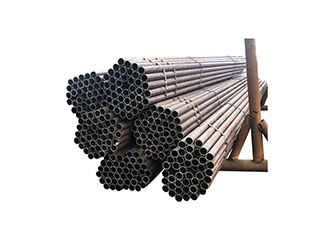
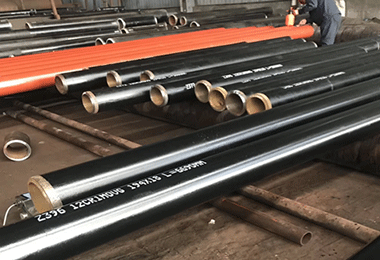
Range 3 casing is casing supplied in joints measuring 34.0 ft to 48.0 ft (10.36 m to 14.63 m) overall length, the longest of the three length ranges defined in API 5CT. It is a length band only: not a grade, not a weight, not a connection. The band is 14 ft wide and the standard sets no average inside it, so what the joints actually measure is decided by the purchase order.
API 5CT groups casing and tubing into three length ranges. R1 runs 16.0–25.0 ft, R2 runs 25.0–34.0 ft, R3 runs 34.0–48.0 ft. A 40 ft joint, a 12 m joint and a 14.5 m joint are all Range 3; a 30 ft joint is Range 2. The range letter on the order line does not constrain the steel grade, the wall thickness or the thread, and it cannot be used on its own to infer a joint count.
What the range does decide is arithmetic: how many joints make up a string, how many make-ups the crew performs, how much a single joint weighs on the catwalk, and whether the pipe fits the transport the buyer has booked. Those four consequences are covered below with worked figures.
The Band and the Limits Inside It
Table 1 gives the three ranges and the one place where API 5CT narrows the band: a rail carload lot of 40,000 lb (18,144 kg) or more. In that case 95 % or more of the footage must fall within the stated variation, and no single joint may be shorter than the stated minimum.
Table 1 — Casing length ranges and the carload limits that apply inside them (API 5CT, 11th edition).
| Range |
Length band |
Metric |
Variation for 95 % or more of carload |
Minimum length in carload |
| R1 |
16.0–25.0 ft |
4.88–7.62 m |
6.0 ft (1.83 m) |
18.0 ft (5.49 m) |
| R2 |
25.0–34.0 ft |
7.62–10.36 m |
5.0 ft (1.52 m) |
28.0 ft (8.53 m) |
| R3 |
34.0–48.0 ft |
10.36–14.63 m |
6.0 ft (1.83 m) |
36.0 ft (10.97 m) |
Two points follow from the table. First, the carload rule applies to footage, not to joint count, and it only bites above 40,000 lb — a single truck load or a small order is governed by the band alone. Second, 36.0 ft is a floor for rail carloads, not an average. A compliant R3 carload can sit between 36.0 ft and 42.0 ft, or between 41.0 ft and 47.0 ft; both are legal and they are not the same pipe to plan with.
The standard sets no minimum average length for R3. Two compliant orders can differ by 1.5 m in average joint length, which over 3,000 m of casing is roughly 28 joints — a difference in make-ups, freight bookings and shoe depth that appears only after the pipe is on site. Buyers who need a predictable count put a minimum average on the purchase order as an agreed term.
How Length Is Measured
For threaded and coupled casing, length is measured with the coupling made up, from the end of the pin to the outer face of the coupling, and recorded to the nearest 0.01 m (0.1 ft). A nominal 40 ft joint is therefore longer than 40 ft of pipe body by the coupling standoff — a small figure per joint that becomes a real figure per string.
Length is not a mandatory marking item in the API 5CT stencil. Where the tally has to reconcile against the drilling program, the order must call for measured length to be marked on each joint or supplied as a joint-by-joint tally. Without that line the buyer receives a range, not a list.
What Range 3 Changes in the String
Longer joints mean fewer joints. Table 2 converts the band into counts and weights, using 9-5/8 in (244.5 mm) 47.00 lb/ft casing as the worked example.
Table 2 — Joint count per 1,000 m and single-joint weight for 9-5/8 in (244.5 mm) 47.00 lb/ft casing. The 9.14 m row is the R2 baseline; counts rounded up; coupling mass and pup joints are additional.
| Average joint length |
Joints per 1,000 m |
Weight per joint |
Make-ups per 1,000 m |
| 9.14 m (30 ft) |
109 |
1,410 lb (0.64 t) |
109 |
| 12.19 m (40 ft) |
82 |
1,880 lb (0.85 t) |
82 |
| 14.63 m (48 ft) |
69 |
2,256 lb (1.02 t) |
69 |
Against a 30 ft R2 string, R3 at 40 ft removes 27 make-ups per 1,000 m. Each removed connection also removes a torque record, a thread-compound application, a centralizer position and a potential leak path, which is the usual commercial argument for the longer range. The trade is handling: a 48 ft joint of 47.00 lb/ft casing is over 1 metric ton before the coupling, and it needs the rig floor, the pipe rack and the crane to suit it.
The Transport Window
R3 spans the container limit, which is why the length line on the order decides the shipping method rather than the other way round.
Table 3 — Nominal internal length by transport type against the Range 3 band. Door openings, bundling and securing allowances reduce the usable figure.
| Transport |
Usable internal length |
Range 3 fits |
| 40 ft container |
≈12.03 m |
Joints up to about 12.0 m, six or seven per box |
| 45 ft high-cube |
≈13.56 m |
Joints up to about 13.5 m |
| Breakbulk / flat rack |
No practical limit at this diameter |
Full 34.0–48.0 ft band |
An order written simply as "Range 3" can therefore be supplied at 14.5 m and still be compliant, while the buyer has booked 40 ft boxes. Stating a maximum length on the order is what prevents that, and it costs nothing at the quotation stage.
Writing Range 3 on a Purchase Order
Six fields turn a permissive band into a workable order. Everything the standard leaves open belongs on the order line, not in a later conversation.
Table 4 — Length-related fields on an API 5CT casing order.
| Field |
What to write and why |
| Range with limits |
"Range 3 (34.0–48.0 ft)" — states the band explicitly so it cannot be read as R2. |
| Minimum average length |
A figure such as 12.19 m (40 ft), since the standard sets none; this is what fixes the joint count. |
| Maximum length |
Matched to the transport, e.g. 12.0 m for 40 ft containers. |
| Jointer policy |
Accepted or not accepted. Jointers are round-thread only, are a per-agreement item, and are a separate line on the tally. |
| Measured-length marking |
Whether length is stenciled per joint or supplied as a tally, since length is not a mandatory stencil item. |
| Tally format |
Joint number, measured length, weight and heat number per joint, so the string reconciles on site. |
What Range 3 Is Not
Range 3 is not a grade — J55, K55, N80 and P110 casing are all available in R3. It is not a weight code, and it is not a connection: BTC, STC and premium threads all appear in R3. Two mills quoting "R3, same grade, same weight" can still deliver different average lengths, which is why the order line matters more than the range letter.
FAQ
What is Range 3 casing?
Range 3 casing is casing furnished in joints of 34.0 ft to 48.0 ft (10.36 m to 14.63 m) overall length, the longest of the three length ranges in API 5CT. It describes length only: Range 3 is not a grade, a weight or a connection type, and the standard sets no minimum average length inside the band.
How long is Range 3 casing in meters?
A Range 3 joint measures between 10.36 m and 14.63 m, the metric equivalents of 34.0 ft and 48.0 ft. For threaded and coupled casing the length is measured with the coupling installed, from the end of the pin to the outer face of the coupling, and is recorded to the nearest 0.01 m (0.1 ft).
Is every Range 3 joint close to 48 ft?
No. The band is wide and the standard does not push joints toward its upper end. Where a carload lot of 40,000 lb (18,144 kg) or more is shipped by rail, 95 % of the footage must fall within a 6.0 ft (1.83 m) variation and no joint may be shorter than 36.0 ft (10.97 m), so a compliant order can contain joints at 11 m and at 13.5 m across carloads.
Does API 5CT specify a minimum average length for Range 3?
No. The length range table limits where joints may sit inside the band, and the carload note limits variation for larger rail shipments, but neither sets an average. Buyers who need a predictable joint count write a minimum average length, such as 12.19 m (40 ft), into the purchase order as an agreed term.
Can Range 3 casing be shipped in containers?
Only up to the container's internal length. A 40 ft container gives about 12.03 m and a 45 ft high-cube about 13.56 m, so R3 joints of 11.5 m to 12.0 m load in a 40 ft box while joints above roughly 13.5 m require breakbulk. Range 3 is a band, which is why the length line on the order decides the shipping method.
How should Range 3 be written on a casing purchase order?
Write the range with its limits and add what the standard leaves open: a minimum average length, a maximum length that suits the transport, whether jointers are accepted, whether measured length is to be stenciled on each joint, and the tally format. "Range 3" alone is a valid API 5CT length but an incomplete order line.