.jpg)
.jpg)
NICKEL ALLOY PIPE
Nickel alloys are among the most popular contemporary alloys and are commonly used for their high resistances to corrosion, heat, pressure and warping.

The name "SA179" reads like a grade, and that is where most confusion starts. In the ASTM and ASME system, A179 and SA179 are product specifications: they fix the chemistry, mechanical limits, heat treatment, testing and tolerances for one specific product form — seamless cold-drawn low-carbon steel tubing for heat exchangers and condensers. The material those specifications point to is ordinary low-carbon steel, the same family as A106 Grade A and A192, chosen for ductility and heat transfer rather than for strength.
This distinction matters at the point of purchase. A buyer who treats SA179 as a "grade" often orders it by name without stating the ordered form, the delivery condition or whether an ASME Code construction applies — and then receives the wrong tube or the wrong document set. The SA and A designations also carry different weight: chemically and mechanically the material is the same, but ASME Code construction expects the SA designation and its documentation.
This guide answers what SA179 actually is, what the material contains, how it is made, what it is used for, how it compares with the adjacent carbon and alloy tube grades, and how to order it without ambiguity.
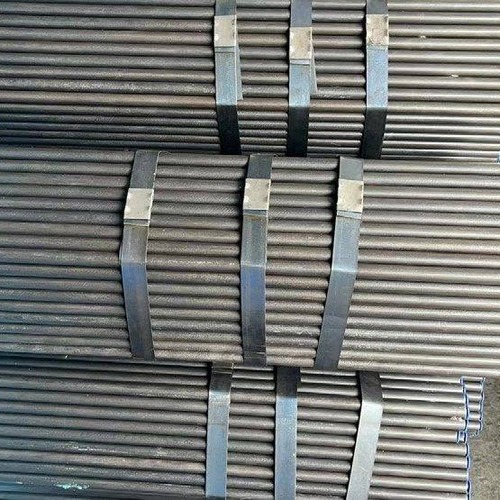
The material behind SA179 is a low-carbon, fully killed (deoxidised) steel. Its composition is deliberately narrow and simple, and the reason is formability rather than strength. Low carbon keeps the tube soft and ductile enough to be rolled and expanded into a tubesheet and cold-bent into U shapes without cracking; the low phosphorus and sulfur limits control inclusions and keep toughness predictable; killing the steel removes dissolved oxygen so the ingot is sound and the properties uniform. No chromium, nickel, molybdenum or other alloying element is added — under the specification, supplying an alloy grade that requires such an addition is not permitted.
| Element, % (heat analysis) | ASTM A179 / ASME SA179 |
|---|---|
| Carbon (C) | 0.06–0.18 |
| Manganese (Mn) | 0.27–0.63 |
| Phosphorus (P) | 0.035 max |
| Sulfur (S) | 0.035 max |
Values are the specification limits; the actual heat chemistry is confirmed on the Material Test Report. Some commercial listings show a sulfur maximum of 0.04 % — that is a transcription error; the specification limit is 0.035 %. The narrow carbon range is what makes SA179 a heat-transfer material rather than a structural one: it can be flared, expanded and bent, which higher-carbon boiler grades tolerate less easily.
SA179 specifies minimum tensile and yield values and a maximum hardness, and adds the forming tests that prove the tube will survive tube-sheet rolling and U-bending. Hardness is the control that matters most in assembly: a tube that meets a tensile figure but exceeds 72 HRBW can crack when rolled and expanded.
| Property | Requirement |
|---|---|
| Tensile strength | ≥ 325 MPa (47 ksi) |
| Yield strength | ≥ 180 MPa (26 ksi) |
| Elongation | ≥ 35 % in 50 mm (2 in); a lower value applies above 2 in outside diameter |
| Hardness | ≤ 72 HRBW |
| Routine acceptance tests | Flattening; flaring, or flange test where wall is under 10 % of outside diameter; hardness; hydrostatic or non-destructive electric test on each tube |
Mechanical property requirements do not apply to tubing smaller than 1/8 in (3.2 mm) inside diameter or 0.015 in (0.4 mm) in thickness. Routine testing is performed on a lot basis for the forming tests (a lot is typically up to 250 tubes of the same size, heat and heat-treatment charge) and on every tube for the pressure or electric test. Confirm the exact schedule against the ordered edition and the Material Test Report.
| Parameter | Typical / specified |
|---|---|
| Product form | Seamless cold-drawn tube; straight lengths or U-bend tubes |
| Outside diameter | 1/8–3 in (3.2–76.2 mm); larger sizes by agreement |
| Wall thickness | Minimum wall, commonly about 1.0–12 mm depending on outside diameter; ordered in mm or by BWG |
| Length | Cut to order; U-bends to the bundle drawing |
| Delivery condition | Annealed; heat treated after the final cold draw at ≥ 650 °C (1200 °F) |
| Tube ends | Plain, square cut and deburred; prepared for expansion where required |
| Surface | Clean and scale-free; pickled or oiled per order |
| Testing | Flattening, flaring, hardness, and hydrostatic or non-destructive electric test (eddy current or ultrasonic) |
| Certification | Material Test Report for A179; full ASME Material Test Report with traceability for SA179; EN 10204 3.1 where specified |
SA179 is a minimum-wall specification: the ordered wall is a floor, and delivered wall is that value or thicker. Wall tolerance is one-sided, so a "nominal wall" quotation and a "minimum wall" quotation are not the same product even at the same price. Confirm tolerances against ASTM A450/A450M and the purchase order.
The following are comparable low-carbon seamless tube grades in other systems. They are material-family matches, not guaranteed drop-in equivalents, and the chemistry and mechanical limits must be verified against the ordered standard.
| System | Grade | Note |
|---|---|---|
| ASTM / ASME | A179 / SA179 | The reference specification |
| EN 10216-2 | P195GH (1.0348) | Low-carbon seamless tube; similar family |
| JIS G3461 | STB340 | Japanese boiler and heat-exchanger tube grade |
| GB 5310 | 20G | Chinese high-pressure boiler tube grade; approximate |
These grades are approximations: their carbon and manganese ranges and their mechanical minimums do not match A179 exactly. Substitution must be confirmed against the design code and the purchase specification, not by grade name alone.
SA179 sits inside a family of carbon and alloy tube and pipe specifications that are easy to confuse. The table separates the ones buyers most often mix up.
| Specification | Construction | Carbon, % | Typical duty / distinction |
|---|---|---|---|
| ASTM A179 / SA179 | Seamless, cold drawn | 0.06–0.18 | Heat-exchanger and condenser tubes; the general-purpose low-carbon heat-transfer tube |
| ASTM A192 / SA192 | Seamless | 0.06–0.18 | High-pressure boiler tubes; similar carbon, higher pressure test for boiler duty |
| ASTM A210 / SA210 A-1 | Seamless, medium carbon | ≤ 0.27 | Boiler and superheater tubes; higher strength than A179 |
| ASTM A214 / SA214 | Electric-resistance-welded | 0.18 max | Welded heat-exchanger and condenser tubes; the welded counterpart of A179 |
| ASTM A178 / SA178 | Electric-resistance-welded | Per grade | Welded boiler tubes; grades A, C and D |
| ASTM A106 / SA106 Gr. B | Seamless pipe | ≤ 0.30 | Pressure piping, not heat-transfer tubing; ordered by NPS |
| ASTM A213 / SA213 T11, T22 | Seamless alloy | Cr-Mo alloy | High-temperature (creep-regime) superheater and heat-exchanger tubes |
The single most common substitution question is A179 against A214 — seamless versus welded for the same heat-exchanger duty. The short answer is that A214 contains a longitudinal weld and A179 does not, so the choice follows whether the design code and specification permit welded tube. See the linked comparison for the full breakdown.
SA179 is a heat-transfer material. It is chosen where a seamless low-carbon wall separates two fluids and carries heat from one to the other, in non-corrosive or properly treated service:
Because the steel is plain carbon without alloy additions, it belongs in media it can tolerate — treated cooling water, steam and condensate, and light hydrocarbons. For corrosive cooling water, sour service or aggressive process streams, alloy or stainless tubes are normally selected instead.
One number is regularly misread. The specification requires the finished tube to be heat treated at 650 °C (1200 °F) or higher after the final cold-draw pass. That is a manufacturing temperature, not a service rating: it relieves drawing stress so the tube can be expanded and bent. The service ceiling is far lower. Carbon steel tubes such as SA179 are commonly used to about 400 °C (750 °F) or below in heat-transfer duty, and the governing limit is the allowable stress in the applicable design code, not the grade name.
Indicative allowable stress values for SA179 rise and fall with temperature as follows. The exact figures are read from the code edition named in the purchase order.
| Temperature | Allowable stress (indicative) |
|---|---|
| 100 °F (38 °C) | 11,700 psi (81 MPa) |
| 200 °F (93 °C) | 11,700 psi (81 MPa) |
| 300 °F (149 °C) | 11,700 psi (81 MPa) |
| 400 °F (204 °C) | 11,300 psi (78 MPa) |
| 500 °F (260 °C) | 10,600 psi (73 MPa) |
| 600 °F (316 °C) | 9,700 psi (67 MPa) |
Values are indicative, taken from ASME Section II Part D for SA179, and must be confirmed against the code edition cited in the purchase order. Above the practical carbon steel range, creep-resistant alloy grades such as ASTM A213 T11 and T22 take over. The allowable stress of a seamless tube is not reduced by a weld joint factor; this is one reason a seamless wall is retained at higher pressure.
SA179 is a low-carbon steel, specifically a killed (fully deoxidised) carbon steel containing 0.06-0.18 % carbon and 0.27-0.63 % manganese. It is not stainless steel and not an alloy steel; no deliberate alloying additions are permitted. The SA179 designation itself is a product specification — the ASME Code version of ASTM A179 — covering seamless cold-drawn tubes for heat exchangers and condensers.
No. SA179 is plain carbon steel. It contains carbon and manganese within a narrow low range, with phosphorus and sulfur each held to 0.035 % maximum, and no chromium, nickel or molybdenum is added. Stainless and alloy heat-exchanger tubes are covered by other specifications, such as ASTM A213 for ferritic and austenitic alloy boiler, superheater and heat-exchanger tubes.
Technically yes. ASME SA179 is the ASME Code adoption of ASTM A179, and the two describe the same material, chemistry, heat treatment and mechanical requirements. The difference is designation and code status: for ASME Code construction, such as ASME-stamped pressure vessels and registered boilers, the SA179 designation must be used, with an ASME Material Test Report and full traceability. For non-code work, A179 is sufficient.
Approximate equivalents in other systems are EN 10216-2 P195GH with material number 1.0348, JIS G3461 STB340, and GB 5310 20G. These are material-family matches for a low-carbon seamless tube, not guaranteed drop-in substitutes; confirm the chemistry and mechanical limits against the ordered standard before substituting.
SA179 is seamless. The specification requires the tube to be made by the seamless process and cold drawn, so there is no longitudinal weld. The welded counterpart for the same heat-exchanger and condenser duty is ASTM A214 / ASME SA214, which is electric-resistance-welded. A quotation for A179 welded tube is a specification error.
In heat-transfer service, carbon steel tubes such as SA179 are commonly limited to about 400 °C (750 °F) or lower, depending on the design code and the medium. Note that the 650 °C (1200 °F) figure in the specification is the heat-treatment temperature after the final cold draw, not a service limit. For higher temperatures, creep-resistant alloy grades such as ASTM A213 T11 and T22 are used instead.
SA179 is used for heat-transfer surfaces where a seamless low-carbon wall is required: shell-and-tube heat exchangers, surface condensers, feedwater heaters, evaporators, economisers, air coolers and similar equipment in power generation, refining, petrochemical and HVAC service. It is suitable for non-corrosive or properly treated water, steam and light-hydrocarbon duty.
Provide the standard and designation, ASTM A179 or ASME SA179; the outside diameter and minimum wall thickness in mm or BWG; length and quantity; and whether straight lengths or U-bend tubes are required. State the heat-treatment condition, tube ends, testing — hydrostatic or non-destructive electric, with eddy-current testing where required — the applicable standard edition and design code, whether an ASME Code construction applies, and the certification scope, such as a full ASME Material Test Report with traceability.